

Introduction
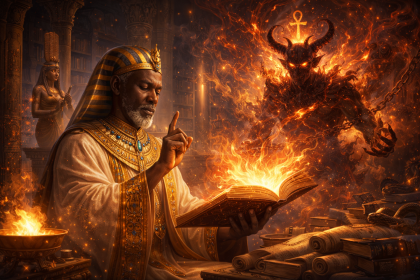
In Ancient Egypt, speech was never neutral. Words were not merely tools for communication; they were forces capable of shaping reality. To speak was to act. To remain silent was, at times, an equally powerful decision.
Kemetic philosophy understood language as creative power governed by ethics. Speech (Hu) and perception or understanding (Sia) were not separate faculties. They worked together to bring order into being—or disorder, if misused.
To understand African philosophy at its core, one must understand why speech required discipline and why silence was considered wisdom.
1. Hu: Speech as Creative Force
In Kemetic thought, Hu refers to authoritative, effective speech—speech that does something rather than merely describing something.
Hu was associated with:
- Creative utterance
- Command aligned with truth
- Speech that brings order into form
This concept appears clearly in creation theology, where the universe comes into being through intentional articulation, not through violence or chance. Speech was understood as a structuring force.
Words were effective only when aligned with Ma’at. Speech divorced from truth lost its creative legitimacy.
2. Sia: Understanding Before Utterance
Speech alone was insufficient. It required Sia—deep perception, awareness, and understanding.
Sia governed:
- Insight
- Discernment
- Comprehension of hidden relationships
In Kemetic philosophy, one did not speak simply because one had the ability to do so. One spoke only after understanding. This hierarchy—understanding before expression—formed the ethical basis of communication.
Speech without Sia was noise.
Speech without Ma’at was danger.
3. Creation Through the Word
The idea that reality is shaped through speech is not metaphorical in Kemetic cosmology.
Creation narratives emphasize:
- Thought preceding form
- Word giving structure to potential
- Order emerging through articulation
This reflects a worldview in which language participates in reality, rather than merely labeling it. The spoken word was an extension of cosmic order when properly used.
This is why sacred names, formulas, and utterances were treated with extreme care.
4. The Moral Weight of Speech
Because speech had power, it also carried responsibility.
Kemetic ethics held that:
- Lies distort reality
- Excessive speech weakens order
- Careless words create imbalance
False speech was not merely immoral; it was cosmically disruptive. To speak against Ma’at was to strengthen Isfet.
This explains the emphasis on restraint, precision, and silence in wisdom literature.
5. Silence as Active Discipline
Silence in African philosophy is often misunderstood as absence or passivity. In Kemet, silence was containment of power.
Silence served to:
- Protect knowledge from misuse
- Preserve depth from distortion
- Allow understanding to mature
The wise were often described as those who knew when not to speak. Silence was not ignorance. It was mastery.
In a world where speech creates consequences, restraint becomes intelligence.
6. Speech, Authority, and Legitimacy
Not everyone had equal right to speak authoritatively.
In Kemet:
- Legitimate speech followed ethical alignment
- Authority was earned, not assumed
- Words carried weight only when spoken from responsibility
This applied to rulers, priests, scribes, and elders alike. Authority was measured not by volume or force, but by alignment with Ma’at.
Powerful speech required moral credibility.
7. African Oral Traditions and Continuity
Across Africa, oral traditions preserve the same philosophical assumptions:
- Words carry force
- Naming brings reality into focus
- Speech can heal or destroy
Elders, griots, and ritual speakers are trained not merely in storytelling, but in ethical speech. The right to speak publicly is granted through maturity, not enthusiasm.
This continuity confirms that Kemetic ideas about speech belong to a broader African epistemology.
8. Modern Speech and the Loss of Restraint
Modern culture often treats speech as consequence-free:
- Constant expression
- Immediate reaction
- Opinion without understanding
From a Kemetic perspective, this represents a profound ethical regression. When speech is unrestrained, reality itself becomes unstable—truth dissolves, trust collapses, and noise replaces meaning.
The crisis of modern discourse is not technical.
It is philosophical.
9. Relearning the Ethics of the Word
- Kemetic philosophy offers a corrective:
- Understand before speaking
- Align words with truth
- Value silence as discipline
- Treat language as responsibility
- Speech should clarify, not inflate.
- Silence should protect, not conceal.
This approach restores dignity to communication and stability to social life.
Conclusion
In Kemet, speech was sacred because it shaped reality. Silence was honored because it preserved order. Together, Hu and Sia formed an ethical system in which language was never neutral and expression was never free of consequence.
To speak was to commit oneself to truth.
To remain silent was to protect meaning.
African philosophy teaches that civilization does not collapse first through violence, but through irresponsible speech.
When words lose weight, reality follows.
Hotep.