
Introduction
Ancient Egyptian philosophy did not divide reality into simplistic categories of “good” and “evil.” Instead, it understood existence as a dynamic balance between two opposing yet inseparable forces: Ma’at and Isfet.
Ma’at represented order, truth, balance, justice, and right measure.
Isfet represented disorder, excess, falsehood, injustice, and rupture.
These were not abstract ideas reserved for priests or philosophers. They were operational principles governing the universe, society, and individual conduct. Civilization itself was defined by the capacity to maintain Ma’at and contain Isfet.
To understand Kemet, one must abandon moral absolutism and grasp this relational philosophy of balance.
1. Ma’at: Order as Alignment
Ma’at was not imposed order. It was alignment with how the universe functions.
It governed:
- The regularity of the Nile’s flood
- The movement of celestial bodies
- The legitimacy of political authority
- The ethics of daily life
Ma’at was neither rigid nor static. It required constant attention and renewal. Order did not maintain itself. It had to be upheld through right action, correct judgment, and disciplined behavior.
In this sense, Ma’at was not perfection.
It was continuous responsibility.
2. Isfet: Disorder as Excess and Rupture
Isfet is often misunderstood as “evil.” This is inaccurate.
Isfet represented:
- Excess rather than lack
- Arrogance rather than ignorance
- Injustice rather than error
- Rupture rather than opposition
Isfet emerged whenever proportion was lost—when power exceeded ethics, when desire overran restraint, when ambition ignored consequence.
Disorder was not external or supernatural.
It was humanly generated misalignment.
3. The Universe as a Moral Field
Kemetic philosophy viewed the universe as morally responsive.
This did not mean that nature punished individuals like a judge. It meant that imbalance produced consequences:
- Unjust rule led to famine or unrest
- Social excess weakened cohesion
- Ethical decay destabilized institutions
Political collapse was therefore not merely strategic failure. It was interpreted as a breakdown of Ma’at.
History itself was read as a moral record.
4. Daily Life Between Ma’at and Isfet
Ma’at and Isfet were not distant cosmic forces. They operated in everyday decisions.
Each action contributed to one or the other:
- Speaking truth reinforced Ma’at
- Lying fed Isfet
- Moderation strengthened order
- Excess invited disorder
Ethics was not confined to ritual. It was embedded in:
- Speech
- Trade
- Family relations
- Governance
- Education
Every person was a participant in cosmic maintenance.
5. Kingship as Balance Management
The Pharaoh’s central task was not conquest or expansion. It was the maintenance of Ma’at.
His responsibilities included:
- Ensuring justice
- Protecting the vulnerable
- Preventing excess among elites
- Maintaining ritual continuity
When rulers failed, the resulting chaos was interpreted as Isfet gaining ground. Leadership was therefore accountable not only to people, but to cosmic order itself.
Power without restraint was illegitimate.
6. Myth as Philosophical Illustration
Kemetic myths dramatized the tension between Ma’at and Isfet.
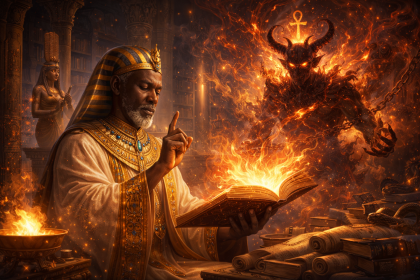
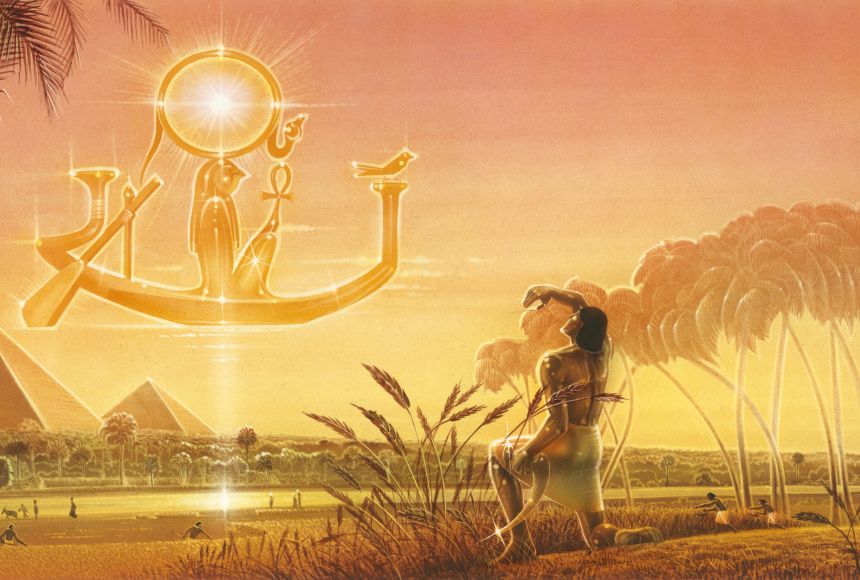
The recurring battle between Ra and the serpent of chaos did not depict a final victory. Chaos returned every night. Order had to be reasserted each day.
This conveyed a key philosophical insight:
- Disorder is never eliminated
- Order must be renewed continuously
- Vigilance is a permanent duty
Civilization was not a finished achievement.
It was an ongoing task.
7. Education Against Isfet
Kemetic education aimed not simply to impart skills, but to discipline excess.
Students were trained to:
- Control speech
- Restrain desire
- Respect hierarchy without servility
- Value balance over dominance
Knowledge without ethics was considered dangerous. Cleverness unmoored from Ma’at became a tool of Isfet.
This explains the emphasis on wisdom literature and moral instruction alongside technical learning.
8. African Continuities of Balance
The Ma’at–Isfet framework reflects a broader African philosophical pattern.
Across the continent, similar principles appear:
- Harmony over accumulation
- Community over ego
- Measure over excess
- Responsibility over entitlement
African philosophy does not deny conflict. It seeks to contain it within order.
This continuity confirms that Kemetic thought was not an anomaly, but a refined expression of a continental worldview.
9. Modern Disorder and the Loss of Measure
Modern societies often misinterpret disorder as freedom.
Excess is celebrated:
- Unlimited growth
- Unrestrained consumption
- Power without moral boundaries
- Speed without reflection
From a Kemetic perspective, these are symptoms of Isfet unchecked.
The resulting crises—environmental destruction, social fragmentation, political instability—are not accidents. They are the consequences of imbalance.
10. Why Balance Is Not Neutral
Balance is often mistaken for passivity. In Kemet, balance required active effort.
Maintaining Ma’at demanded:
- Courage to restrain power
- Willingness to limit desire
- Discipline to resist excess
- Patience to preserve continuity
Neutrality in the face of disorder was complicity. Balance required engagement, not withdrawal.
Conclusion
Ma’at and Isfet do not describe a battle between light and darkness. They describe the conditions under which civilization survives or collapses.
Order must be maintained. Disorder must be contained. Neither task ends.
Kemetic philosophy teaches that civilization is fragile—not because humans are weak, but because balance demands constant responsibility.
To choose Ma’at is not to reject conflict.
It is to refuse excess.
To understand Isfet is not to fear chaos.
It is to recognize its source.
In every age, the question remains the same:
Will order be maintained,
or will imbalance prevail?
Hotep.