
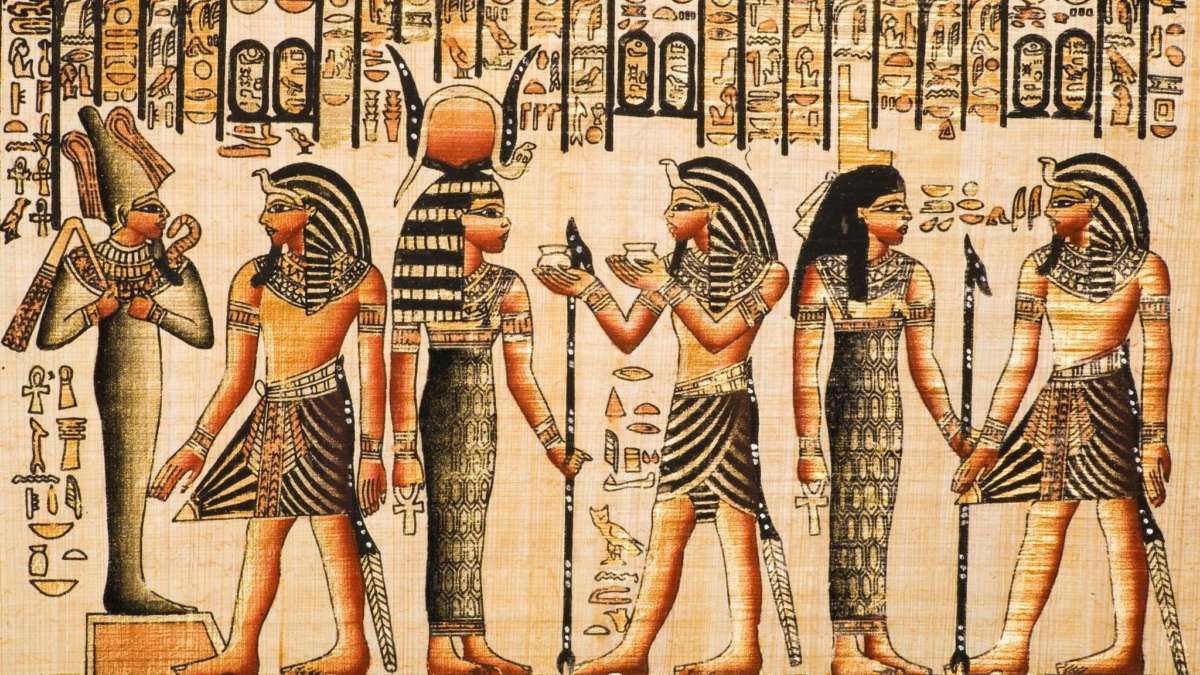
The word Hotep is often misunderstood, misused, or reduced to a slogan. In reality, Hotep is a foundational Kemetic concept—one that expresses a complete vision of peace, balance, offering, and right relationship.
Hotep is not a greeting alone.
It is a state of alignment.
To understand Hotep is to understand how harmony was conceived, cultivated, and maintained in Ancient Egypt and across African philosophical traditions.
1. The Meaning of Hotep
In the Kemetic language, Hotep conveys several interconnected meanings:
- Peace
- Satisfaction
- Rest
- Offering
- Harmony after completion
These meanings are not separate. They describe a process: when actions are correct, balanced, and complete, peace naturally follows. Hotep is therefore not passive calm, but peace as the result of right action.
In temple contexts, Hotep is associated with offerings made to restore balance between humans, nature, and the divine.
2. Hotep as Offering, Not Request
A crucial aspect of Hotep is the idea of giving rather than asking.
In Kemetic spirituality:
- Offerings were acts of restoration, not transactions
- One offered to maintain Ma’at, not to bargain with the divine
- Peace followed alignment, not desire
Hotep expresses the understanding that harmony is produced through responsibility, not demanded as a right.
This distinguishes Kemetic spirituality from systems centered on fear, guilt, or submission.
3. Hotep and Ma’at
Hotep cannot be separated from Ma’at.
Ma’at is the law of balance.
Hotep is the state achieved when Ma’at is upheld.
When:
- A ruler governs justly
- A person lives truthfully
- Society respects order and proportion
The result is Hotep.
In this sense, Hotep is not a moral instruction but an outcome—the visible calm that emerges from ethical structure.
4. Hotep in Social and Daily Life
Hotep was not confined to temples or rituals. It shaped everyday behavior.
To live toward Hotep meant:
- Avoiding excess
- Acting with restraint
- Speaking truthfully
- Respecting one’s place within the whole
Peace was not understood as the absence of conflict, but as the presence of balance.
This vision resonates with many African societies where harmony within the community takes precedence over individual dominance.
5. Hotep and the Body
Hotep also had a physical and psychological dimension.
Rest, satisfaction, and completion were seen as essential to:
- Mental clarity
- Spiritual receptivity
- Social stability
A society constantly agitated, greedy, or disordered could not produce Hotep. Peace required discipline, rhythm, and limits.
In this sense, Hotep is incompatible with chaos, noise, and excess.
6. The Misuse of Hotep
In modern contexts, the word Hotep has sometimes been detached from its philosophical depth and reduced to caricature or ideological posture.
This misuse obscures the original meaning:
- Hotep is not superiority
- Hotep is not rhetoric
- Hotep is not performance
True Hotep is quiet, grounded, and earned.
To invoke Hotep without Ma’at is to empty the word of substance.
7. Hotep as African Philosophy
Hotep reflects a broader African philosophical pattern:
- Peace as consequence, not goal
- Harmony over domination
- Balance over accumulation
- Completion over endless pursuit
African philosophy does not chase peace—it creates the conditions for it.
This approach stands in contrast to systems that seek calm while ignoring structure, ethics, and responsibility.
Conclusion
Hotep is not a word to be worn.
It is a condition to be reached.
It is the peace that follows truth, the calm that follows justice, and the rest that follows correct action. In Kemetic thought, one does not ask for Hotep.
One becomes worthy of it.
Hotep.